|
|
 |
|
|
 previous previous | Page 2 of 2 | | 
 | | Exclusive Interview |
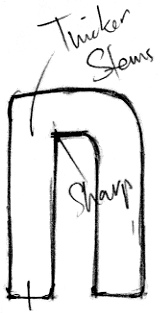
Page 2 of 2 At this point in his notebook, it was clear how all these different ideas were beginning to converge: the heavy type forms, the traditional English typestyles and this intriguing idea of a multiple master based on geography, but rather than Europe, it was to be based on the counties of England and on typestyles which were popular around the time of the Industrial revolution. Clearly indicated is a large circle diagram divided up a bit like a dartboard (two inner circular sections crossed by lines from the centre to the circumference) with the names of various English Shires written into each section. "Originally it was going to be huge - all the shires you can find in the centre of England represented by forms based on local typestyles. In the end, though, I got it down to six. Derbyshire represents the industrial north and Birmingham and the black country lends weight to the heavyness of the typefaces. As you move towards Wales, Cheshire and Shropshire you have these rounder, more unceil forms and then, when you get down to Warwickshire and Worcestershire, the shapes all become very cuddly and dumpy and round. The eventual scheme was intuitively rather than facually based on the reality of local type styles, but is no less interesting for all that. "Yes, it didn't fully work. I moved a few of the typefaces around to better fit the wheel and I had to squeeze it here and there to make it fit what I wanted to do and also what people need from a typeface nowadays. Also, I wanted a sans, I wanted a serif, I wanted a lower case and script." It looks almost like an anthropological survey. "Yes, it's like a map. It can't speak to you, but it builds character into the type forms. Some letters - like S - are constant throughout the whole family. Others just take on different peculiarities. The basic shapes came from the grotesque and Egyptian lettering styles. I did away with things like Italic because they're all designed to fit together so that, for example, if you're using Derbyshire, which is very straight and square, you can mix in the rounder Worcestershire forms as script highlights. You can also mix all the different fonts together to create a logotype. There are lots of options." I gaze in wonder at all the planning and illustrations as Mr Tankard explains all the possibilities he toyed with. "I just kept writing the ideas down. Everything is in the book because otherwise you generate so much paper." I suppose these are the sparks and you develop them elsewhere. "It was odd with the Shire Types because I'd done pretty much finished sketches so I knew what I wanted and just had to move the forms around and play with them at a later date and make them work. With these I didn't do finished drawings. I'm trying to move away from that because I wasn't taught to draw type properly and you always have to put them on the computer anyway. I haven't got the right equipment to digitize the types so I just draw them in books and scan them in and work with them on screen." Jeremy Tankard's real enthusiasm is for type as a thing of beauty in itself. He loves word shapes and combinations and likes going into some detail with ligatures and sorts and something he calls colour which I asked him about. "Well, you've got the letter shapes and when the letters make words you have a grey-scaling colour on the page and it's usually what defines a typeface. What makes something more interesting and different is the general colour on the page and the image it gives. Alchemy (another of his newest fonts) is this way and it has this kind of feeling and these kind of shapes. Some serif typefaces, things like Bembo, the old ones really have a lot of life in them - sparkle." I can imagine The Shire Types being a real hit with the English Tourist Board, but equally, I think they could serve some really fun purpose - like fruit drinks or CD sleeves perhaps. I asked if it bothered him that somebody will take these forms and give them a context which might be some distance from his original ideas. "Not really. As long as they've bought it. In fact it'll be interesting to see what someone else does. " The Shire Types. Big and black is back - you read it here first. ' The Shire Types ' from Jeremy Tankard is the latest of the Fontworks Special Editions. For more information, call Fontworks Sales on (0)207 490 5390. |
| | | Page 2 of 2 |  |
|
|
 
  

 | Guest |  |
 |
0 items |
 |
View |
|
| Total |
|
£ 0.00 |
|  |
| |
|
| 
Receive regular e-news bulletins packed with new releases and special offers!
|
|
|
Key benefits:
- shop without c/card
- monthly invoice
- purchase history
- backup resource
- premium content
|
|
| |
|  |
|  |
| |
|
| |
|
|
|
|
|
 |
|
|
|
|